
There is a moment in almost every renovation when drawings, measurements, and mood boards suddenly become real. You stop thinking about the room as a project and start imagining what it will actually feel like to walk into it every morning.
Marble often creates that moment.
Finding marble tile for sale is easy. Finding marble that has the right color, veining, finish, dimensions, and character for a particular room takes more thought. Natural stone is not a manufactured surface where every piece is expected to look identical. Variation is part of the material. In fact, it is one of the main reasons people choose marble in the first place.
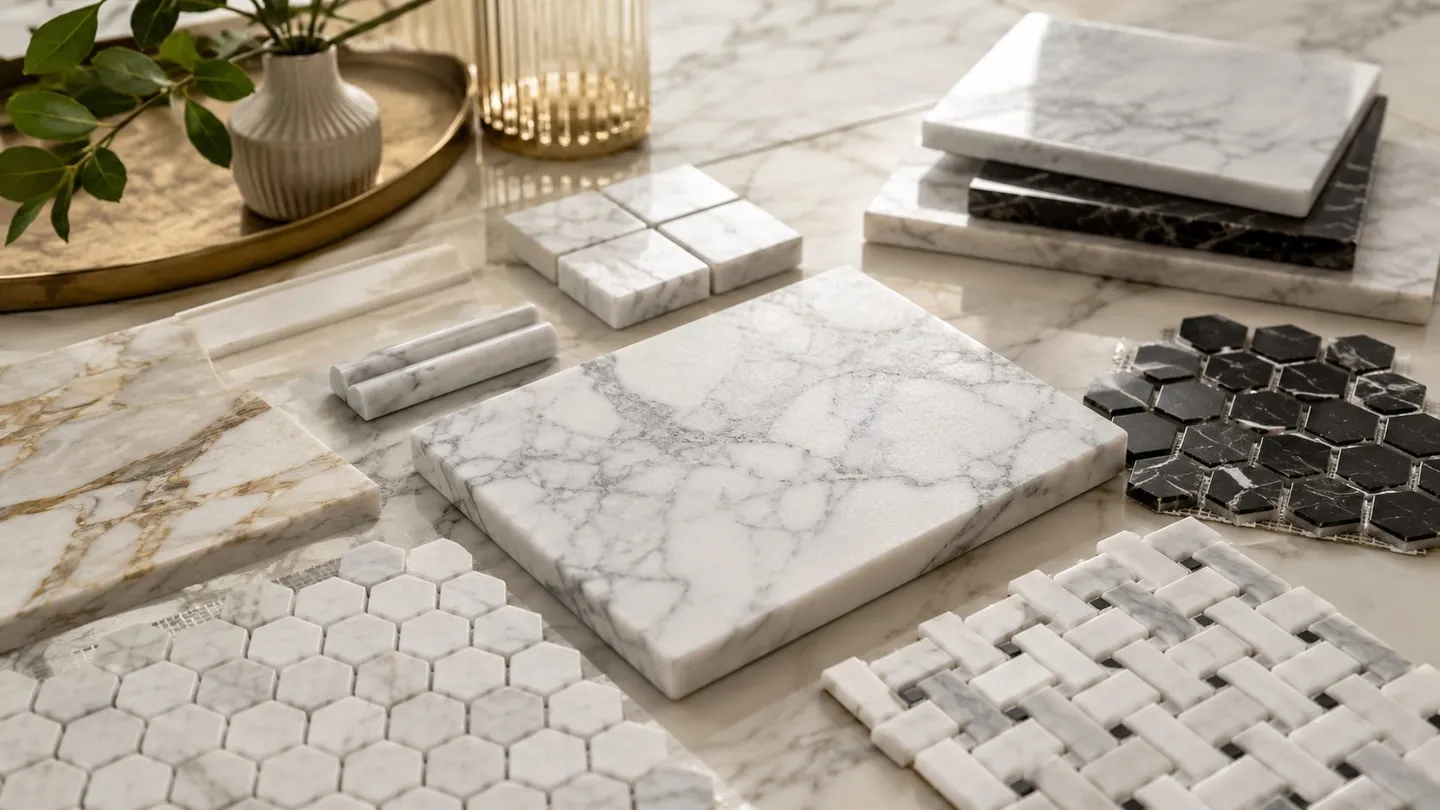
A Carrara bathroom can feel calm and restrained. Nero Marquina can turn a relatively simple powder room into something dramatic. Calacatta Gold introduces warmer veining that works beautifully alongside brass, cream cabinetry, or natural wood. Smaller mosaics can completely change the visual rhythm of a shower floor or backsplash.
The important question, therefore, is not simply:
“Which marble looks best?”
A better question is:
“Which marble will look best in this particular space, under these conditions, and with the other materials I have already chosen?”
That distinction can prevent expensive mistakes.
Why Marble Tile Continues to Have Such a Strong Interior Presence
Natural marble has depth that printed surfaces struggle to imitate.
Look closely at genuine stone and the difference becomes apparent. Veins do not simply sit on top of the material as decoration. Color shifts, mineral deposits, cloudy areas, fine lines, and occasional stronger markings are integrated into the stone itself.
That unpredictability gives marble personality.
When homeowners search for marble tile for sale, they are often attracted to luxurious photographs of completed kitchens and bathrooms. Yet the most successful marble interiors are rarely successful because someone simply selected an expensive stone. They work because the designer considered scale, finish, pattern, grout, lighting, and surrounding materials together.
Surfaces Galore, for example, offers natural stone collections including Carrara White, Calacatta Gold, Arabescato Corchia, Bardiglio, Bianco Dolomite, Nero Marquina, Thassos White, Crema Marfil and other distinctive materials. The selection extends beyond conventional rectangular tiles into mosaics, checkerboards, borders, trims, patterned designs and custom mosaics.
This matters because the same marble can create remarkably different results depending on its format.
A large Carrara tile may create a quiet background.
The same stone cut into hexagons immediately becomes more decorative.
Put contrasting marble into a checkerboard pattern and suddenly the floor becomes one of the dominant architectural features of the room.
Material is only half of the design decision. Format is the other half.
What to Examine When You Find Marble Tile for Sale
Price naturally matters, particularly when covering a large floor or multiple bathrooms. But buying purely according to price per square foot can be misleading.
Several other factors deserve equal attention.
Stone Type and Natural Character
Start with the marble itself.
Carrara White is recognizable for its light background and gray veining. It can work particularly well when the objective is an understated, timeless interior rather than an aggressively luxurious one.
Calacatta Gold has a different personality. Its creamy white background and stronger gold-toned veining can introduce warmth and visual drama.
Nero Marquina goes in almost the opposite direction. Its deep black color with contrasting white veining makes it suitable for interiors where marble is supposed to attract attention rather than quietly support the rest of the design.
Then there are materials such as Bianco Dolomite, Arabescato Corchia, Bardiglio, Thassos White and many others.
Rather than asking whether one is objectively better, consider the atmosphere you want.
Do you want soft or dramatic?
Warm or cool?
Traditional or contemporary?
Subtle movement or bold veining?
Answer those questions before becoming attached to a specific photograph.
Polished vs. Honed Marble: A Small Decision With a Big Visual Effect
Finish deserves serious consideration when evaluating marble tile for sale.
Polished marble reflects more light and emphasizes color and veining. It can produce the glamorous surface many people associate with luxury hotels, elegant entrances, and formal bathrooms.
Honed marble has a softer, matte appearance.
Neither finish is automatically superior.
Imagine the same Carrara White stone in two bathrooms. The first has polished marble, chrome fittings, glass, and bright lighting. It may feel crisp, luminous, and formal.
The second uses honed Carrara alongside oak cabinetry, brushed metal, and warm indirect lighting. The stone becomes quieter and more relaxed.
Same marble. Completely different mood.
For wet areas, surface characteristics also become a practical consideration. A honed mosaic can be particularly attractive for shower applications because the smaller pieces and numerous grout joints can contribute to a more practical floor layout while maintaining the character of natural stone.
The key is to choose finish according to both appearance and application.
Why Marble Mosaic Tile Can Solve Difficult Design Problems
A marble mosaic tile is not merely a miniature version of a larger floor tile.
Mosaics introduce pattern, movement, additional grout lines, and opportunities to combine contrasting materials. They can also adapt naturally to smaller spaces and architectural details.
Surfaces Galore carries mosaic options in forms including squares, hexagons, basketweave arrangements, herringbone-inspired designs, checkerboards and other decorative configurations.
Consider Carrara White.
A simple 3-by-3-inch Carrara mosaic preserves the familiar white-and-gray character of the stone while creating a more detailed surface. A Carrara hexagon introduces geometric movement. A basketweave or contrasting pattern can push the design toward a more traditional decorative aesthetic.
This is why designers often combine formats rather than covering an entire room with one tile.
A Practical Bathroom Scenario
Imagine a primary bathroom with a walk-in shower.
One approach would be to use medium or larger Carrara tiles on the main bathroom floor and shower walls. The surfaces remain visually calm because there are fewer grout joints.
Inside the shower, however, a smaller marble mosaic tile can be introduced on the floor.
Now there is contrast without introducing another material.
The stone color remains consistent, but the scale changes.
A niche could repeat the mosaic, visually connecting two areas of the shower. Alternatively, the niche could use the larger wall tile for a quieter appearance.
This type of repetition is subtle, but it often makes an installation feel deliberately designed rather than assembled from unrelated products.
Marble Tile for Sale for Kitchens: Think Beyond the Backsplash Photograph
Kitchen marble deserves its own discussion because kitchens contain so many competing surfaces.
Cabinetry, countertops, appliances, hardware, floors, paint, lighting, and backsplashes all occupy the same visual field.
That makes restraint valuable.
If the countertop already contains strong veining, adding an equally dramatic marble mosaic tile behind it can make the kitchen feel unnecessarily busy.
On the other hand, relatively plain countertops and simple cabinetry provide room for a more expressive backsplash.
Suppose you have warm white cabinets, natural oak flooring, brushed brass hardware, and a restrained countertop. Calacatta Gold marble could establish a connection between those warm elements without making the kitchen feel beige or monotonous.
A different home might contain black cabinetry and stainless steel details. Here, a crisp white marble or even a carefully placed black-and-white pattern could create a much stronger architectural statement.
The best tile is not necessarily the tile that attracts the most attention in isolation. It is the one that makes the entire room look better.
How to Buy Marble Tiles Online Without Seeing the Entire Order in Person
The ability to buy marble tiles online has made specialized natural stone accessible to homeowners and professionals who may not live near a dedicated stone showroom.
However, natural variation creates an obvious concern.
“What if the marble looks different when it arrives?”
That is a reasonable question.
Natural stone cannot be treated like a solid-color ceramic product. Two pieces from the same marble family can contain different vein concentrations, markings, and tonal variations.
This is exactly why samples are useful.
Surfaces Galore provides sample ordering, allowing customers to evaluate color and texture before committing to a larger purchase. That can be particularly valuable when coordinating marble with cabinets, countertops, paint, wood, or metal finishes.
A sample should not be interpreted as a guarantee that every tile will be visually identical.
Instead, use it to understand the stone's general color family, surface finish, texture, and character.
Then allow for natural variation in the final installation.
Look at Marble Under Your Actual Lighting
This simple step is frequently overlooked.
Take the sample into the room where the material will be installed.
Look at it in daylight.
Then look again at night.
Place it vertically if it will become a backsplash or shower wall. Put it horizontally on the floor if that is its intended application.
Warm artificial lighting can change the apparent tone of white and gray marble significantly. A marble that seems cool in a showroom photograph may appear warmer beside cream cabinetry. Conversely, certain gray veins may become more noticeable next to bright white fixtures.
Do not judge a stone solely from a screen.
Calculate Quantity Before Ordering Marble Tile for Sale
One of the most frustrating renovation problems is discovering halfway through installation that there is not enough material.
Ordering exactly the measured square footage is usually unwise.
Cuts create waste. Tiles can break. Certain pieces may contain markings that you would prefer to place somewhere less prominent. Complicated layouts can increase offcuts substantially.
Extra material also gives the installer greater freedom to arrange natural variation attractively.
For example, imagine a bathroom requires approximately 120 square feet of tile. Ordering exactly 120 square feet leaves almost no flexibility. If several pieces need significant cuts around corners, plumbing penetrations, or niches, the margin disappears quickly.
Pattern complexity matters too.
Straight layouts tend to generate different waste levels than diagonal patterns, intricate borders, or designs requiring extensive alignment.
Before placing an order, discuss expected waste with the installer and calculate the required quantity according to the actual layout rather than guessing.
A few additional tiles at the beginning can be far less expensive than interrupting the project later.
Dry Layout Is Especially Important With Natural Marble
This is one of the most useful practical recommendations for natural stone.
Do not simply open the first box and install tile after tile in the order they appear.
Lay out multiple pieces first.
Why?
Because marble naturally varies.
One tile might have strong veining while the next is almost quiet. Another may contain a darker mineral area. Individually, every piece can look beautiful. Installed randomly, however, several heavily veined pieces might accidentally become concentrated in one corner.
Dry laying allows the installer to distribute variation intentionally.
“Move that stronger vein toward the vanity.”
“Keep the quieter pieces around the niche.”
“Let's separate these two darker tiles.”
Those tiny decisions can dramatically improve the completed installation.
With a marble mosaic tile, inspect multiple sheets as well. Mesh-mounted mosaics simplify installation, but the installer should still evaluate pattern alignment, stone variation, and spacing before setting the material permanently.
Large Marble Tiles vs. Marble Mosaic Tile
Neither format wins universally.
They perform different visual jobs.
Larger Tiles
Larger marble tiles generally create fewer grout lines, allowing the natural veining to become the main visual feature. They can make floors and walls appear broader and less interrupted.
They are particularly effective for:
• Bathroom walls• Main floors• Feature walls• Spacious entrances• Areas where the stone itself should dominate
Marble Mosaics
Mosaics create more texture and pattern.
They are particularly useful for:
• Shower floors• Kitchen backsplashes• Niches• Borders• Decorative floors• Feature areas• Smaller architectural details
There is also a third option: use both.
This is often the most sophisticated approach.
A larger tile creates visual calm while the mosaic introduces controlled detail. Because both can come from the same marble family, the contrast does not have to feel forced.
Marble Tile for Sale and the Question of Maintenance
Natural marble is beautiful, but pretending that it requires no thought after installation does customers no favors.
Marble is a natural stone and should be treated accordingly.
Spills, moisture, cleaning products, sealing requirements, and the specific application all deserve consideration. Acidic substances are particularly relevant because marble is calcium-based and can react to acids.
That means aggressive cleaners are not automatically better cleaners.
Homeowners should follow appropriate natural-stone care instructions and discuss sealing with their installer or stone professional according to the material and location.
This is also where expectations matter.
Some homeowners want a surface to remain visually pristine for as long as possible.
Others appreciate the way natural materials develop character over time.
Neither attitude is wrong.
But you should know which type of owner you are before covering a heavily used area with natural marble.
Why Cheap Marble Can Become Expensive
When comparing marble tile for sale, the lowest initial price can be tempting.
But price per square foot tells only part of the story.
Material consistency, stone grade, cutting quality, finish, packaging, availability, shipping protection, and customer support all influence the real cost of an installation.
Poorly prepared material can increase sorting time. Inconsistent dimensions can make installation more complicated. Excessive breakage creates waste. And replacing unavailable material in the middle of a project can become particularly frustrating.
Surfaces Galorepositions its collection around premium natural stone rather than competing solely on the lowest possible price. The company offers hand-selected marble and mosaics, samples, insured shipping, and assistance with choosing materials. Its collections include both familiar classics and more distinctive stones, giving buyers considerable freedom when coordinating an entire project.
For a small decorative backsplash, the difference between bargain material and carefully selected marble may not represent a huge percentage of the total renovation budget.
Yet visually, it can matter every single day.
What to Check Before You Buy Marble Tiles Online
Before you buy marble tiles online, slow down and confirm several practical details.
• Measure the installation area carefully.• Determine whether the tile is intended for a wall, floor, shower, backsplash, or decorative feature.• Compare polished and honed finishes.• Order a sample when color coordination is important.• Check individual tile or mosaic-sheet dimensions.• Review thickness and coverage information.• Discuss waste allowance with the installer.• Consider grout color before installation begins.• Plan transitions between marble and surrounding flooring or wall materials.• Remember that natural variation is expected rather than a defect.• Inspect delivered material before installation.• Dry lay tiles from multiple boxes to distribute veining attractively.
These steps are not glamorous.
They are, however, exactly the kind of details that separate a beautiful concept from a successful finished room.
Using Contrasting Marble Without Making a Room Too Busy
Mixing marble colors can produce spectacular results, but contrast needs discipline.
Black-and-white checkerboard flooring is a classic example. Carrara White paired with a darker stone can immediately establish an architectural identity.
Nero Marquina with white accents creates an even stronger contrast.
But if the floor is already highly patterned, the surrounding walls may benefit from restraint.
This is where people sometimes make the mistake of choosing every surface independently.
They find a dramatic floor they love.
Then a dramatic backsplash.
Then heavily veined countertops.
Then ornate hardware.
Every item may be attractive individually, yet together they compete.
A useful principle is to decide which surface gets to be the star.
If the marble mosaic tile is visually dominant, allow surrounding materials to support it.
If a dramatic slab countertop is the focal point, consider quieter marble elsewhere.
Luxury is often about editing.
Custom Mosaics: When Standard Patterns Are Not Enough
Some projects need something more individual than a standard square or hexagon.
Custom mosaics provide opportunities to combine stone colors, patterns, and shapes for specific architectural concepts. Surfaces Galore offers custom marble and travertine mosaic options suitable for areas such as floors, walls, and backsplashes.
This can be particularly useful in entryways, boutique commercial interiors, bathrooms with a defined historical style, or projects where designers want a repeated motif.
Custom does not automatically mean extravagant.
A restrained border around an otherwise simple floor can be enough.
Likewise, a small decorative section inside a shower niche may create more impact than covering an entire wall with a complicated pattern.
The objective should always be intentionality.
A Realistic Example: Designing a Carrara Bathroom
Consider a homeowner renovating a medium-sized primary bathroom.
The brief is simple: bright, elegant, traditional enough to age well, but not so formal that the room feels like a hotel lobby.
Carrara White becomes an obvious candidate.
Instead of using the same format everywhere, the homeowner chooses larger honed Carrara tiles for the main walls. The matte surface softens the appearance of the stone.
A smaller Carrara marble mosaic tile is selected for the shower floor.
The vanity is natural wood rather than white. This introduces warmth and prevents the room from becoming overly monochromatic. Hardware is kept simple.
Before installation, several boxes of tile are opened and the pieces are dry laid. Two tiles contain significantly darker veins than the others.
Rather than rejecting them, the installer positions them strategically where the stronger movement looks intentional.
That decision costs almost nothing.
Yet it can make the final wall look substantially better.
This example illustrates something important: successful marble design depends as much on placement and coordination as on the stone itself.
Choosing Marble That You Will Still Like Ten Years From Now
Trends matter, but permanent surfaces should not be selected purely because they are fashionable this year.
Ask yourself whether you genuinely like the stone itself.
Would you still choose Carrara without seeing it repeatedly on social media?
Does that dramatic checkerboard floor fit the architecture of your home?
Are you choosing an unusual mosaic because it expresses your style, or because you have seen it in dozens of recent photographs?
There is nothing wrong with contemporary inspiration.
The goal is simply to distinguish inspiration from impulse.
Natural marble has been used architecturally for centuries precisely because it does not depend on one temporary design trend. The format surrounding it can change, but the material itself has extraordinary staying power.
Final Recommendation: Choose Marble as Part of the Whole Room
Searching for marble tile for sale should be the beginning of the decision, not the end.
Start with the room.
Consider its size, natural light, artificial lighting, cabinetry, countertops, fixtures, furniture, and intended atmosphere. Then decide whether the marble should provide a quiet background or become a focal point.
Compare stone families. Examine polished and honed finishes. Think about scale. Use marble mosaic tile strategically where texture, grip, pattern, or visual detail adds something meaningful.
And before you buy marble tiles online, order samples when possible, calculate quantities carefully, allow for installation waste, and remember that natural variation is part of what you are purchasing.
Surfaces Galore offers a broad selection of marble tiles, mosaics, checkerboard designs, decorative elements, and custom options across stones such as Carrara White, Calacatta Gold, Arabescato Corchia, Bardiglio, Bianco Dolomite, Nero Marquina, and Thassos White. That variety makes it possible to approach marble as a complete design system rather than simply choosing one attractive tile.
Most importantly, do not rush the selection.
A beautiful marble installation can remain part of a home for decades. Spending additional time considering finish, format, placement, and surrounding materials is worth it.
Choose the stone you want to keep looking at—not merely the one that looked impressive for five seconds on a screen.